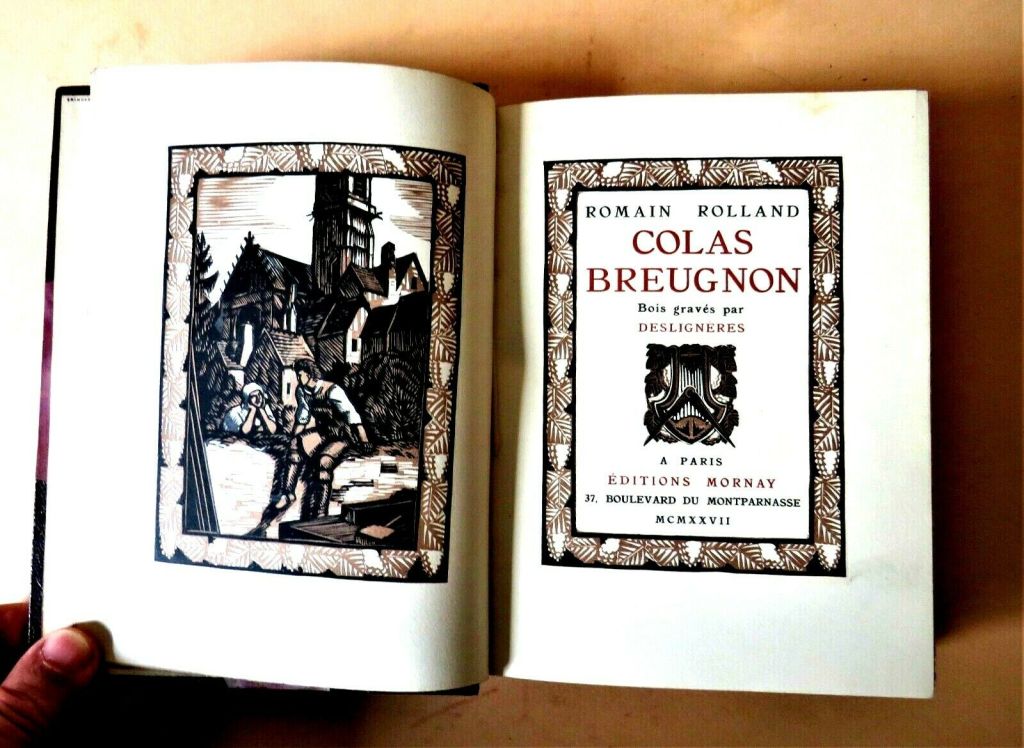
‘Colas Breugnon, a good chap, Burgundian, rounded in his manners and his appearance, no longer in the prime of his youth, 50 years have passed, stocky, healthy teeth, eyes as sharp as a hawk, and hair still firmly on my head, despite some greying.’
« Colas Breugnon, bon garçon, Bourguignon, rond de façons et du bedon, plus de la première jeunesse, cinquante ans bien sonnés, mais râblé, les dents saines, l’œil frais comme un gardon, et le poil qui tient dru au cuir, quoique grison. »
The self-introduction by Colas Breugnon sets the scene as this colourful Burgundian character sits down to write his memoirs. The atypical novel by Nobel prize-winning author Romain Rolland relates his troubles and joys, and his philosophical insights and indominable spirit, all written in a unique and witty vernacular.
The book is set in his hometown of Clamecy and the surrounding countryside, sometime in the XVII century, and is a lively, poetic celebration of the rustic life and the people, culture and language of the region. Written before the war, but published only in 1919, the novel is partly autobiographical and is also a subtle social commentary on society and war, in line with much of Rolland’s life and writings.
The book is a series of anecdotes and encounters that shape Colas’ life during a year of upheavals. The year opens with the attack and siege of Clamecy by troops from nearby Vézelay, in which we discover the vulnerability and ingenuity of the inhabitants of Clamecy – and the importance of wine in reconciling even the most violent of confrontations.
‘When we left the table, Vézeliens and Clamecycois, we held each other in much higher esteem than we did at the soup: it is in eating that we learn what a man is worth. Whoever loves what is good, I love him: he is a good Burgundian.’

« Quand nous sortîmes de table, Vézeliens et Clamecycois, nous avions les uns pour les autres bien plus d’estime qu’au potage : c’est au manger que l’on apprend ce que vaut l’homme. Qui aime ce qui est bon, je l’aime : il est bon Bourguignon. »
Colas introduces us to his friend the Curé Chamaille (the local priest) of Brèves, a locality close to Clamecy. In the form of a fable about the shepherd, the wolf and the lamb, Colas illustrates how the small people of this world are always the victims, even of those who claim to protect them…
Although mocking of the popular superstitions and hypocrisy of the Catholic Church, warmed by the flow of Burgundy and the unholy trinity of ‘saint Irancy, saint Chablis, or Pouilly’ (all Burgundy wines), Colas shares his popular faith and unorthodox perspective on God, whom he loves, but confesses that ‘one God is not enough for me (…) I have my saints, and fairies and spirits too’, a celebration of the simple beauties of nature and human life.
The evening ends with yet more wine, and songs to the glory of Bacchus and Jesus, and a prayer for his ‘soft, human and generous spirit’ to be poured on the people of France.
Colas experiences tragic moments during the year, losing his wife and his house and very nearly his own life, but his courage and positive spirit never desert him. As he lies immobilized on his sick bed, he discovers the transformative power of books, and the universal experience of human life he explores in his reading comes as a revelation to him.
‘The sorrows and joys of the universe are mine (…) Much better than in life, I feel through my books the brotherhood that binds us all (…) for of each other there remains only ashes and the flame that, nourished by the marrow of our souls, rises, unique and multiple, towards heaven, singing with the thousand tongues of the bloody mouth the glory of the Almighty.’
« Les peines et les joies de l’univers sont miennes (…) Bien mieux que dans la vie, je sens à travers mes livres la fraternité qui nous lie, nous tous (…) car des uns et des autres il ne reste que cendres et la flamme qui, nourrie de la moelle de nos âmes, monte, unique et multiple, vers le ciel, en chantant avec les mille langues de la bouche sanglante la gloire du Tout-Puissant. »
The novel concludes with a social appeal in the spirit of Uncle Benjamin, the other great literary figure of Clamecy:
‘And then, to be frank, between us, my children, a good king is very good; but the best is still me. Let us be free, my kindly Frenchmen, and let our masters be fed! My land and I love each other, we are enough. What do I need a king of heaven or earth? I have no need of a throne, neither here below nor there above. To each his place in the sun, and his shadow! To each his piece of the earth, and his arms to turn it! We ask for nothing else.’
« Et puis, pour être francs, entre nous, mes enfants, un bon roi est bien bon ; mais le meilleur, c’est encore moi. Soyons libres, gentils François, et nos maîtres envoyons paître ! Ma terre et moi nous nous aimons, nous suffisons. Qu’ai-je affaire d’un roi du ciel, ou de la terre ? Je n’ai besoin d’un trône, ici-bas, ni là-haut. À chacun sa place au soleil, et son ombre ! À chacun son lopin du sol, et ses bras pour le retourner ! Nous ne demandons rien d’autre. »
 Le Vieux Château